
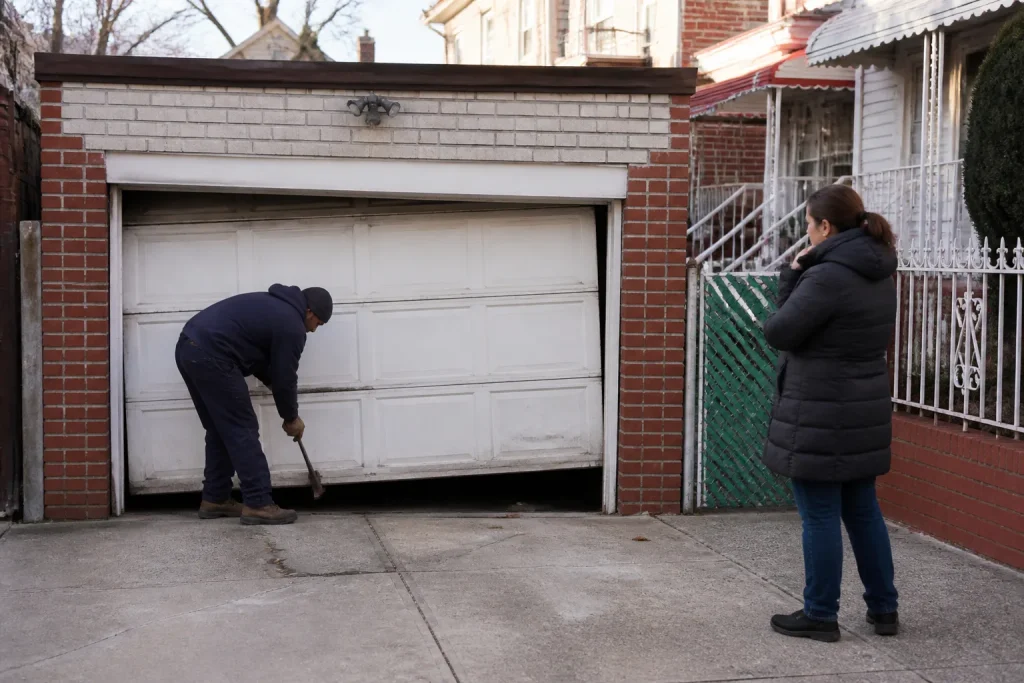
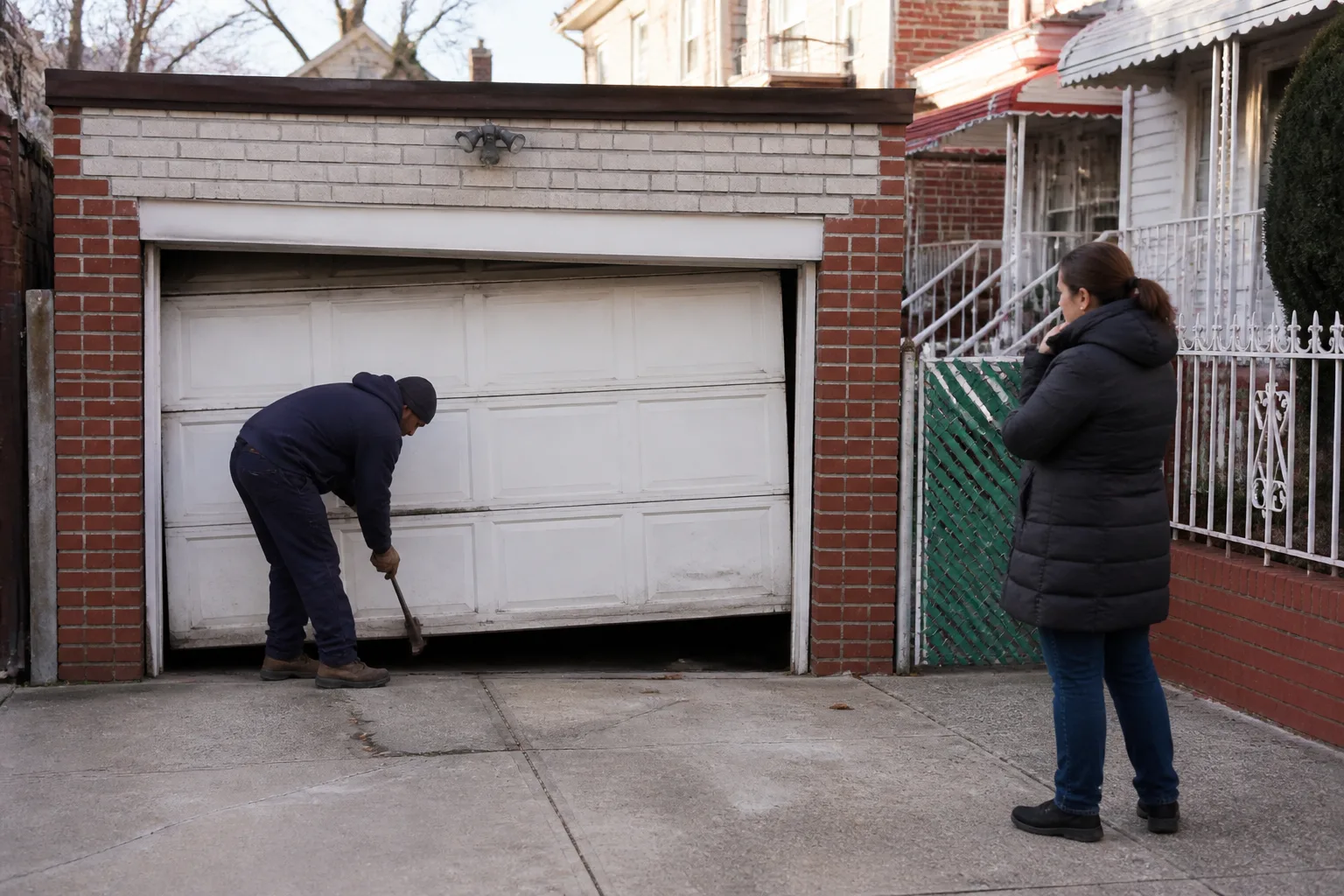
Garage Door Repair: Repair or Replace? How East New York Homeowners Decide
A single $300 repair on a 15-year-old door isn’t a red flag. The same door’s third repair in two years is. Most homeowners don’t add up those receipts until someone asks them to, and once they do, the math usually changes the answer. The real question isn’t “how much does this fix cost?” It’s “how much have I already spent, and what’s left in this door’s mechanical life?” That’s the framework we use with East New York homeowners, and it’s the one this post walks through.
If you’d rather have someone look at your door instead of diagnosing it yourself, call (877) 492-2281. Estimates are free, and we answer 24/7.
What’s the 24-month repair cost rule for garage doors?
Here’s the rule: if your total garage door repairs over the past 24 months add up to more than 40% of what a new door and install would cost, replacement wins financially over any 3-year horizon. Pull your receipts – spring replacements, cable work, opener boards, roller sets, panel repairs, track straightening. Add them up. If a new door and installation in East New York runs, say, a few thousand dollars, then $1,200 or more in repairs over two years is your signal.
Why 24 months? Because that’s roughly the window where garage door failure patterns repeat. A door that needed one garage door repair in two years is normal wear. A door that’s on its third problem in the same window isn’t wearing out – it’s failing structurally, and every repair is buying weeks, not years.
- Under 40%: Repair. Your door has life left and the fixes are holding.
- At or near 40%: Get a written comparison. Repair is defensible, replacement is defensible. Ask for both numbers.
- Over 40%: Replacement wins financially. Every further repair is money into a door that’s already telling you it’s done.
What we won’t do is talk you into a door you don’t need. The 40% rule cuts both ways – sometimes it says repair, clearly.
Which structural problems make repair a temporary fix?
Some problems are mechanical and fixable. Others are structural – and when a door has structural damage, even an excellent repair is a patch, not a cure. A competent technician can get your door working again. It won’t stay fixed under daily use, and you’ll keep paying for the same failure in different clothing.
Watch for these three:
- Warped bottom sections. Wood and some older composite doors absorb moisture and bow. Once the bottom section warps, it doesn’t seal, it drags on the weather stripping, and the door rides out of balance. You can replace a bottom section, but if two or more panels are warped, you’re rebuilding a door piece by piece.
- Compromised top bracket mounts. The top bracket carries the weight and force of the whole door. When the wood or steel behind it is soft, cracked or pulling loose, no amount of bracket adjustment holds. The fix is structural – reinforcing the frame – and if the frame is too far gone, replacement is the honest answer.
- Rust past the surface on steel panels. Surface rust on a steel panel is cosmetic. Rust that’s bubbling through the steel, flaking on the inside face, or starting at seams and bottom edges has eaten into the metal. A panel in that condition has lost its stiffness and its load path.
In our experience inspecting doors across East New York, these three account for most of the “we keep fixing it and it keeps breaking” cases. Repair can’t reverse structural decay.
How does the age of your opener factor into the door decision?
Replacing a door while keeping a 12-year-old opener is usually false economy. It’s the single most common mistake we see: homeowners budget for a new door, then flinch at the opener and keep the old one. The new door – heavier, tighter, differently balanced – gets bolted to a tired motor that’s already at the end of its realistic service life. Within a year, the opener fails, and you’re paying for a second job that could have been one.
A few things to weigh:
- Openers get harder to service with age. A Craftsman or Genie unit that’s twelve to fifteen years old may have parts that are no longer made or hard to source. Diagnostics and repair get slower and more expensive.
- New doors change the load. An insulated steel door weighs more than a thin, uninsulated one. An older opener rated for the lighter door may strain under the new one.
- Safety features. Modern openers have reversing systems and force limits that older units simply don’t. Keeping a very old opener on a smart new door is a compromise you don’t need to make.
If you’re replacing the door, replace the opener with it – and pick a brand with a strong service ecosystem. We work on LiftMaster, Chamberlain, Genie and Craftsman systems, so whichever garage door opener repair or replacement path you take, we can diagnose the system rather than just the symptom. If the opener is healthy, under eight years and rated for the door’s weight, keep it. Don’t replace what’s working.
What does East New York housing stock mean for your decision?
East New York’s older attached and semi-attached housing changes the repair-or-replace math in ways that don’t show up in a generic guide. A few local realities to weigh before you commit to a full garage door installation:
- Sizing is not always standard. Garages in older East New York homes were built to the car of the era, not to today’s standard opening dimensions. A replacement door often needs an exact measure and sometimes a custom size. That raises the replacement figure – which makes the 24-month repair rule stricter, not looser.
- Shared walls and attached garages. In attached and semi-attached homes, the garage shares a wall with living space. Insulation matters more than it does in a detached garage. A properly insulated door protects the rooms behind that wall from cold and noise. But if the garage is unheated and never used as living space, you may not need a premium insulated panel.
- Installation complexity. Older framing isn’t always square or plumb, and the header above the opening may not meet current structural requirements. A straight swap can turn into prep work – which is why a free measure and a written price matter more than a phone quote.
- Weather and age. A door facing the street takes the full weight of every season. Consider what the exterior face of yours looks like – that’s the first hint at how much life is left.
Brand choice matters here too. Wayne Dalton and Raynor panels are common in this housing stock, and knowing what’s already on your door helps you compare like for like. We’re certified to work on both, along with Clopay, Amarr and the four opener brands we mentioned above.
When does repair almost always win?
Repair is the right call in one scenario that comes up more than you’d think: a solid-core door with one failed mechanical component, paired with a healthy opener and undamaged hardware. That door has good bones. It simply broke one part.
Springs and cables fail because of cycles, not neglect. They’re wear items. If the door itself is sound and the opener is doing its job, there’s no case for replacing the whole system over a spring or a cable. Springs are also one of the jobs we’d never advise a homeowner to attempt. The spring under tension is one of the most dangerous parts of any residential garage, and a snapped spring or a suddenly released cable can cause serious injury. This is a job for trained hands with the right tools.
We handle spring repair in-house rather than passing it out, and we see the same pattern again and again: a solid door, one failed part, and a homeowner convinced they need a full replacement. They don’t. The right fix, not the biggest one, is what a good diagnosis gives you.
When to call a pro
Some of this you can check yourself – look at the door’s bottom edge, feel for softness around the top bracket, and gather your repair receipts. But when springs, cables or brackets are involved, call a trained technician. And if your door won’t open, won’t stay closed, or you suspect structural damage, emergency service is available – call (877) 492-2281. We answer 24/7, and fast dispatch runs from 7am to 7pm, Sunday through Friday. Our technicians have up to 15 years of experience, and the price is quoted and agreed before any work starts.
Related services in East New York: Garage Door Repair East New York, garage door repair, garage door opener repair, and garage door installation – whichever your door needs, it’s one call.
The Bottom Line
Add up your last 24 months of repair receipts. If that figure tops 40% of a replacement, replace. If it’s well under, repair and save the door’s remaining life. Then weigh the structural signs – warped sections, soft bracket mounts, rust past the surface – and factor in opener age before you commit. A solid door with one failed part is a repair every time.
If you’re in East New York and need help, Garage Door Repair East New York offers free estimates. Call (877) 492-2281. We answer 24/7, with fast dispatch from 7am to 7pm, Sunday through Friday.
Frequently Asked Questions
Use the 24-month rule: if repairs over the past two years exceed 40% of replacement cost, replace. If they’re well under that, repair. Add structural checks – warped panels, soft bracket mounts, rust past the surface – because those make repair a temporary fix regardless of price.
It depends on the job, and we don’t quote over the phone. Call (877) 492-2281 for a free estimate, and we’ll give you a written price before any work starts.
No. We quote the price after we see the door, agree it with you, and that written estimate is the price. Nothing gets added afterward without your okay.
Yes, and often you should. If the door is solid-core with healthy hardware and a working opener, a failed spring is a repair, not a replacement. Springs are one of the most dangerous parts to handle, so this is a job for a trained technician.
Written by the team at Garage Door Repair East New York.
Need Garage Door Help?
Call Garage Door Repair East New York - the local pro we connect you with is licensed and insured, here with fast help in East New York.
(877) 492-2281