
Top Signs You Need Garage Door Service – Don’t Ignore These
A garage door that takes three extra seconds to fully open isn’t being slow. It’s telling you the spring tension is off, and that’s the load threshold where cables start slipping off their drums. By the time a cable snaps, that slow door has been asking for a service call for a couple of months. The signs are almost always there before the breakdown. Most homeowners just don’t know what they’re hearing or seeing. If you’d rather not crawl around under a door that’s already misbehaving, call (877) 492-2281.
What do the sounds coming from my garage door mean?
Sound is the cheapest diagnostic tool you own. Every noise a garage door makes points at a different component, and the difference matters. In our experience across East New York, homeowners tend to lump all garage door noise into “it’s just getting old,” which is how a small fix turns into an emergency call.
- Grinding, metal on metal: usually dry or worn rollers, or a torsion tube that needs lubrication. Left alone, a seized roller starts eating the track it rides in.
- Loud popping or a bang that sounds like a gunshot: a torsion spring breaking. That sound marks the moment the door becomes a manual door until someone trained gets to it. Stop using the opener.
- Rattling that shakes the whole frame: loose hinges, brackets or bolts backing out. Easy to tighten, but if the rattle keeps returning, the fasteners may be pulling from fatigued metal.
- High-pitched squealing: a roller or bearing running without grease, or a belt-drive opener (common on LiftMaster and Chamberlain units) with a worn belt.
One noise to take seriously: a sharp snap followed by silence from the opener. That’s a cable letting go, and it can whip. Don’t stand under the door, don’t try to raise it by hand, and don’t prop it open. Call service instead.
What can I check from the ground without touching anything?
Plenty, and it takes about two minutes. You don’t need a ladder for any of these. This is the visual checklist we’d hand any East New York homeowner who asks what to watch for:
- Cable fraying. Look at the cables running down each side of the door. A healthy cable is a clean, even coil. A cable with broken strands poking out, or one that looks like a fuzzy wire brush, is about to fail and needs a technician.
- Roller wear. The rollers are the wheels in the track. They should be round and quiet. Flat spots, chipped edges, or a roller that wobbles on its stem means replacement.
- Bottom seal. The rubber strip along the bottom edge. Cracked, torn, or missing chunks mean drafts, water, and pests getting in. It’s a cheap part and one of the few fixes a handy homeowner can do safely.
- Rust patterns on the springs. A little surface rust on an older spring is normal. Flaking rust, a visible curve in the coil, or gaps between coils point to fatigue. Springs don’t fail gracefully.
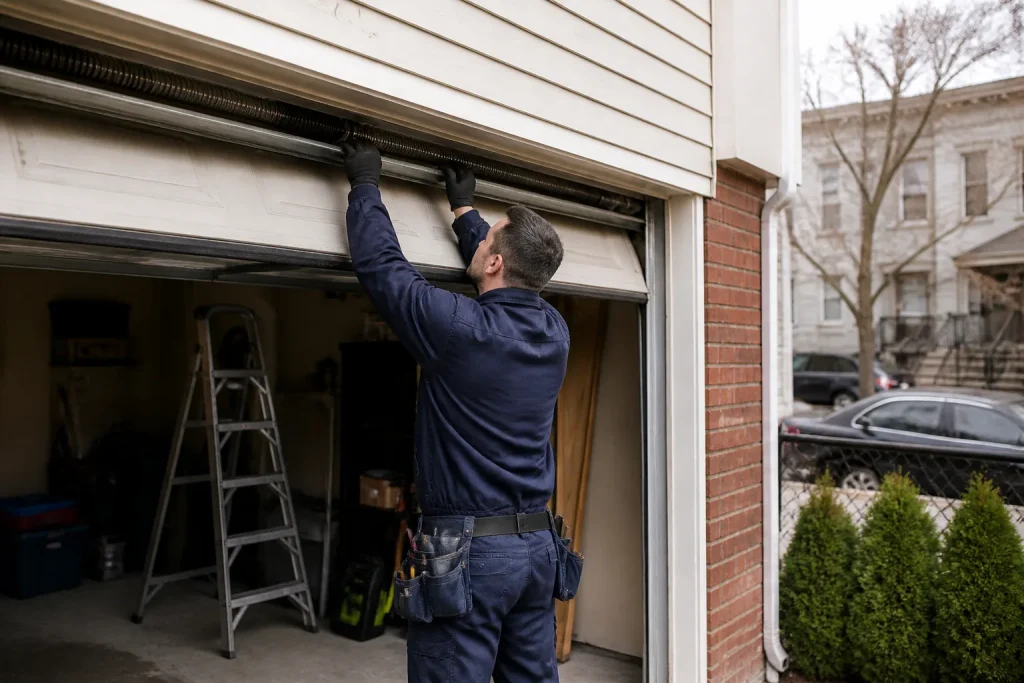
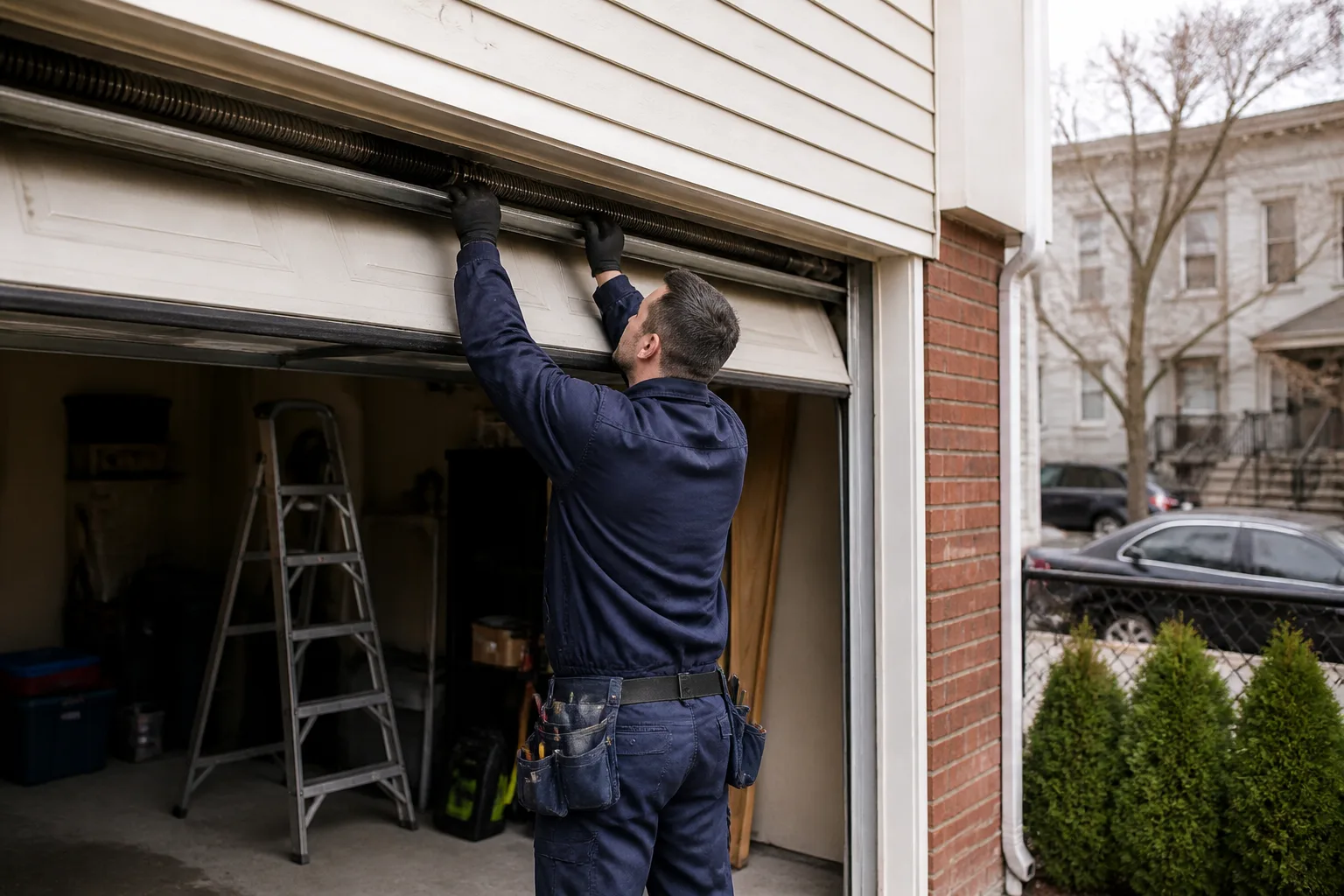
What you should not do is reach up and touch the springs or cables, or try to loosen any of the hardware holding them under tension. A torsion spring carries enough stored force to cause serious injury, and it will release without warning if you back off the wrong bolt. This is one area where a pro is the only sensible option.
Why does my door move unevenly or drift on one side?
A door that rises crooked is nearly always a spring problem, not a track problem. Homeowners in East New York often assume the track is bent because the door looks like it’s wobbling in the rails, but a side-to-side tilt or a door that drifts down on one corner means the two springs aren’t carrying equal tension.
Here’s the test. Close the door and watch the gap between the bottom edge and the floor as it comes down. If one side touches down before the other, or the door hangs visibly lower on the left or right, the tension is unequal. Run the door halfway up and stop it. If it slides down on its own rather than holding where you put it, the springs are losing their ability to hold the door’s weight.
Unequal tension overloads the stronger side, wears the cables on the weak side, and puts stress on one corner of the panels. What starts as a small imbalance becomes a bent track, worn rollers, and eventually a snapped cable. Spring equalizing needs the right tools and a trained hand. That’s a job for a technician, not a weekend project. Doors we service on Craftsman and Raynor setups follow the same rule: the springs set the balance, and the track just follows the door.
Why does my door open fine but reverse before it closes?
This is the one that drives people up the wall, and it’s almost never the sensors. In our experience, most “waving at the eye every morning” fixes treat the symptom, not the cause. A door that opens cleanly and then reverses partway down is usually a limit or travel calibration issue in the opener, especially on older LiftMaster and Chamberlain units with mechanical travel limits that have drifted.
Before you assume calibration, rule out the basics:
- Check that nothing blocks either photo eye (the two small lenses at the base of the track) and that the lenses face each other squarely. Sunlight hitting one eye at an angle can cause false trips.
- Look for a small child’s toy, a chunk of ice, or a leaf in the door’s path. Simple, and it happens more than you’d think.
- If the eyes are clean and aligned and the door still reverses, the opener’s travel limits or force settings are the likely culprit. These need adjusting by someone who knows the unit, because pushing the force setting too high defeats the safety reverse, and that’s how doors crush things.
If the opener is a Genie or Chamberlain model that beeps or flashes a code when it reverses, that code tells you exactly what the unit thinks went wrong. A technician reads it in seconds. You don’t have to guess.
When is it a DIY tune-up and when do you call a pro?
The line is clearer than most people expect. About $30 in lubricant and a screwdriver handles a fair chunk of routine maintenance. Anything involving springs, cables, or the opener’s force settings needs a trained technician, and on this trade that’s not a sales line, it’s basic safety.
Safe for a homeowner:
- Spraying lubricant on the rollers, hinges, and torsion tube (never on the springs themselves).
- Tightening loose hinge and bracket bolts with a socket wrench.
- Wiping the tracks clean, brushing out grit, and checking that no track is bent.
- Replacing a worn bottom seal.
- Cleaning and realigning the photo eyes.
Call a technician within the week:
- Any frayed or broken cable.
- A broken spring, a loud bang from above the door, or a door that won’t lift at all.
- A door hanging crooked or drifting down on one side.
- A bent track that’s clearly out of line or a door off its rollers.
- An opener that reverses before closing after the eyes are clean and aligned.
Any of those means we need hands on the door, not a phone diagnosis. We answer 24/7, with fast dispatch from 7am to 7pm, Sunday through Friday, and we’re closed Saturday. If a spring lets go on a Saturday, call and we’ll book you for Sunday.
Related services in East New York
If a sign above has turned into a real problem, our garage door repair page covers how we diagnose and fix it. A noisy or misbehaving opener usually points to a different fix, so see our garage door opener repair service. If the door has outlived its hardware, we also handle garage door installation. Whatever the fix, the price is quoted and agreed before any work starts, so there are no surprises at the end.
Key Takeaways
- Grinding, popping, rattling and squealing each point at a different worn component.
- Cables, roller wear, bottom seal and spring rust are all visible from the ground.
- An uneven door is usually unequal spring tension, not a bent track.
- A door that reverses before closing is usually a calibration issue, not the sensors.
- Lubricant and a screwdriver cover the small stuff. Springs, cables and force settings are a pro’s job.
The Bottom Line
Garage doors are honest machines. They tell you when something’s wearing out, weeks before they actually fail. Listen for grinding, popping or squealing, watch for crooked movement and cables with frayed strands, and don’t shrug off a door that reverses before it closes. Catching any of those early is what keeps a minor repair from turning into an emergency call. Our technicians have up to 15 years of experience, are covered to work across LiftMaster, Chamberlain, Genie, Craftsman and other major brands, and treat springs as a job we handle ourselves rather than pass along. If you’re in East New York and need help, Garage Door Repair East New York offers free estimates. Call (877) 492-2281 and we’ll take a look. We answer 24/7, with fast dispatch from 7am to 7pm, Sunday through Friday.
Frequently Asked Questions
A door that moves unevenly or drifts down on one side is the most common early sign. It usually means the springs aren’t carrying equal tension, which wears the cables on the weaker side. Call (877) 492-2281 for an exact quote, and estimates are free.
No. Springs and cables carry stored force that can cause serious injury, and even a cautious homeowner can get hurt removing the wrong piece of hardware. A trained technician needs to handle those jobs. Call us to book a visit, and the price is agreed in writing before work starts.
If the photo eyes are clean and aligned and the door still reverses, it’s usually an opener travel or force calibration issue, not a sensor problem. That needs adjusting by someone who knows your unit. Call (877) 492-2281 and we can diagnose it for you.
It depends on the cause. A rattle or squeal from worn rollers or dry hinges is a routine repair. A persistent pop or a door with heavily fatigued springs may point to a system that’s due for replacement. A free estimate will tell you which. Call (877) 492-2281.
Written by the team at Garage Door Repair East New York.
Need Garage Door Help?
Call Garage Door Repair East New York - the local pro we connect you with is licensed and insured, here with fast help in East New York.
(877) 492-2281